Riding the avalanche
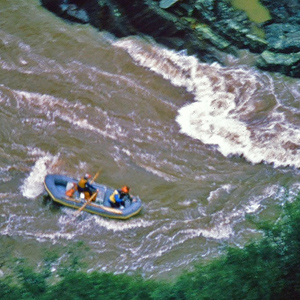
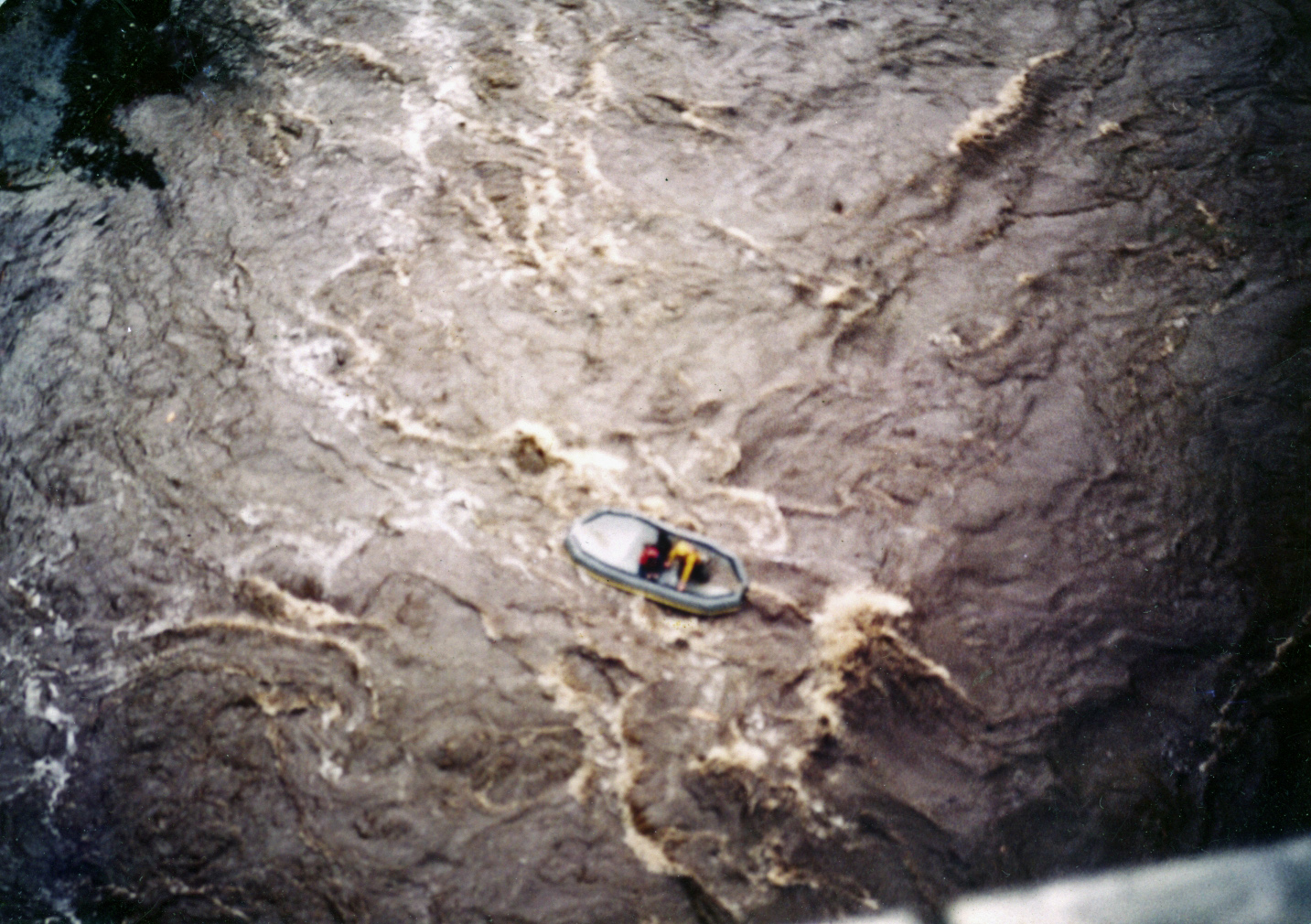
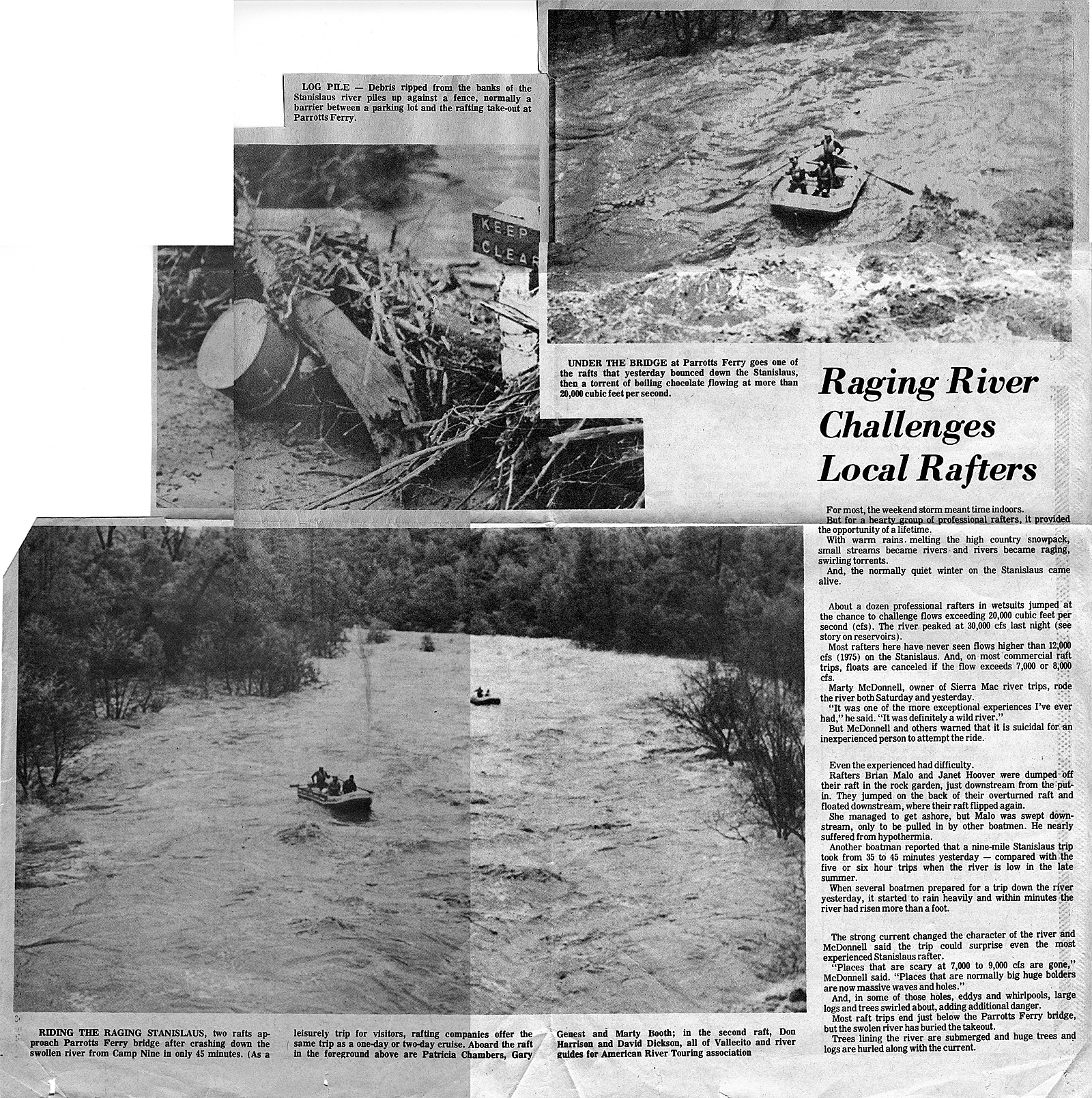
We are flung by a turbulent eddy toward the main river current only to come up sharp against the line tying us to shore. Then, just as quickly, our 16-foot whitewater river raft is tossed back into the bank with a jolt. We’re thrown back and forth like sneakers in a washing machine.
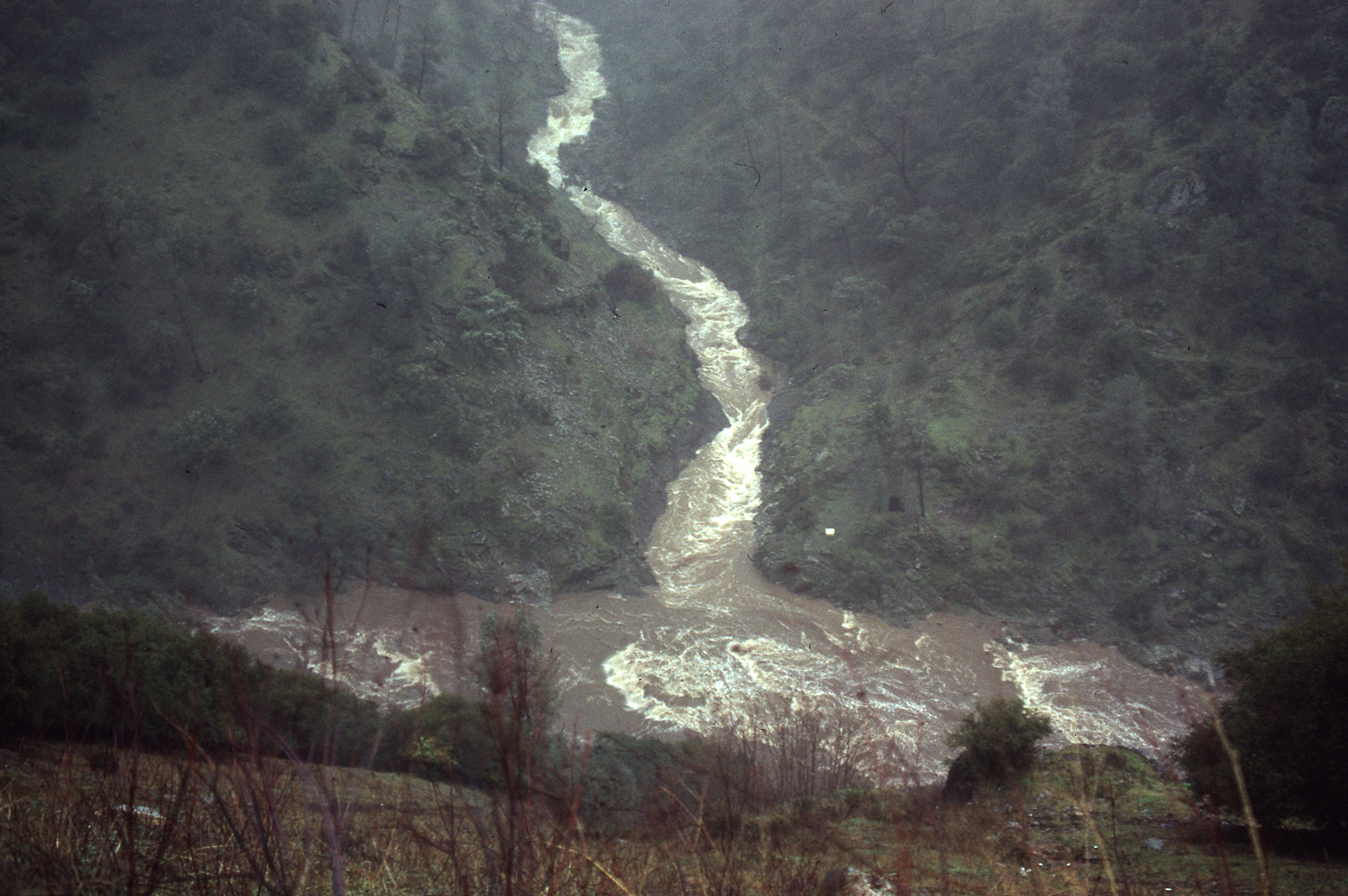
We are hemmed in by the Stanislaus River canyon in California that is experiencing the biggest flood it has seen for decades, if not centuries.
Personally, I ‘ve never seen this river running this high, not even close. I never will again, and I know it, since even if it ever achieves this level again I will never be as foolhardy.
Is it too late to take out?
I don’t dare voice this concern to my passengers—one, an experienced Grand Canyon dory guide and the other, on his very first river trip. I swear I had a good reason for inviting him. Dories were introduced as river boats on the Colorado and became legendary as one of the best ways to experience that ride through the Grand Canyon. But they are guided very differently than the rubber raft we are now in. That difference turned out to be important.
I look around the best I can despite rain coating my glasses. I’m at the oars, waiting to start something I’m increasingly doubtful about. There are a dozen other boats being tossed around in what’s normally a calm eddy at put-in on the Stanislaus River. An eddy is a recirculation that forms after the river passes an obstruction—a boulder or a part of the shore that juts into the river. While the main current keeps flowing downstream, some water is pushed out to refill the area behind the obstacle. This refill then flows back upstream and around the eddy again and again. Usually eddies are calm parts of the river, but not today.
This really bad idea began when a warm, water-laden storm from the Pacific made landfall in California, dumping its liquid load for days on the heavy Sierra snowpack. The result is the biggest flood anyone can remember and why an unorganized group of commercial river guides all descended at the same time on the Stanislaus, which runs out of the Sierra Nevada between the Gold Rush towns of Angels Camp to the north and Columbia to the south. We simply had to see it.
“Hey, let’s boat this thing! Who’s with me?”, Marty yells over the noise made by a river completely out of control. Marty McDonnell owns one of the commercial rafting companies. His challenge is met with a widespread ‘Hell yes!’ Maybe because we’ve never seen such a thing and are astonished at the opportunity, no one, including me, pauses to count the potential cost.
As a group, we are choosing to overlook the obvious dangers. Grand Canyon-style water is crashing through a narrow canyon created by a fraction of today’s flow. Large trees swallowed by the current are now a part of the river and make potentially lethal strainers that can trap both boats and swimmers. Trees unmoored are tossed like matchsticks in breaking waves while it all plunges over massive boulders the size of trucks. And there is the ever-present threat of hypothermia, from the cold rain to the snow-melt river water. It’s all a shitshow, and our lives are most definitely on the line.
Every one of us is both extremely excited and nearly transfixed with fear. We hesitate at the precipice of both extremes, but we all end up falling into the excited path, despite our knowledge that we are putting it all on the line. We feel like we’ll never have this chance ever again in our lifetimes, so we choose to experience it, if only this once.
We are all experienced commercial Stanislaus River guides with thousands of trips down the river between us. What called us all to this river, at this moment—with little or no coordination —was our sense that this would be both our first and last opportunity to experience this flow in this canyon.
We had fought hard to protect the river from the New Melones Dam, but we had lost. In a cynical move, the Army Corps of Engineers is turning the river back on itself, forcing it to drown the magnificent canyon that took eons to carve out of limestone bedrock. This cathedral of nature will soon become a tomb to the incredible diversity of plant and animal species that thrive here. This awareness hangs over us like a pall. The rain adds to my sense of doom.
I check in with my own feelings – what are our chances? Can I row this? I’ve been on the Grand Canyon but this is unlike anything you see there. The top three miles will be one constant rapid which I’ve never experienced anywhere. My gut instinct is telling me hell no, and again, I wonder if it’s too late to pull out. I look around. No one is pulling out. From the deepest part of me, I realize I don’t want to miss this once-in-a-lifetime event, no matter the danger.
All of us are in oar boats, which are rafts that have 10-foot oars wielded by a guide in the middle of the typical 16-foot raft. The other kind of whitewater raft is a paddle boat, where the passengers (often three to a side) each have a paddle and the guide has a longer paddle in the back. The guide calls commands to the passengers about when and how to paddle. But today we need all of the advantages we can possibly muster and we can’t afford to rely on the varying strengths, abilities, and attention spans of individual paddlers.
I pull my baseball cap lower over my brow to shield my glasses better and adjust the hood of my rain parka. My lifejacket wraps around the wool I wear in the hope that it keeps me warm, even if soaking wet. Today, of all days, a lifejacket is the single most important piece of gear any of us have, and we all know it.
I’m estimating the flow to be about 30,000 cubic feet per second, as I’ve seen that kind of flow in the Grand Canyon (later we would find out that the flow peaked at 43,600 CFS that night). But this is on a river where even a small fraction of that flow is considered water so dangerous that commercial rafting companies cancel their trips. We all want someone nearby if we flip our boat, a very real possibility in these conditions. With this velocity you may not be pulled from the water for miles. And as cold as this snowmelt water is, hypothermia is a very real danger.
It’s as if Jeff reads my mind as he shouts, “No one goes until everyone’s ready, then we all go one after another as quickly as possible! That way we can all back each other up!”
The essential problem is that none of us has ever seen this river before. Sure, we’re all very experienced Stanislaus River guides, but at this flow everything is different. Large rocks that you never paid attention to before because you just went around them can cause huge holes or standing waves much bigger than your boat. Named rapids can be entirely washed out while nameless curves in the watercourse become giant, boat-flipping monsters. You just don’t know. Everything must be run sight unseen with only the barest minimum of clues about what lies below. In the first three miles, where the river falls most precipitously, there will be no way even to stop. There will be no eddies. And the rain makes everything more difficult.
“Have you ever seen this much water?” I yell over to an old-timer.
“Not even close!” he yells back. “This is several times higher than I’ve ever seen,” calling out loudly to be heard over the noise of the flood and rain. “But I wouldn’t miss it for the world,” is the last thing I hear.
Everyone is now in their boats. Just one person per boat remains at the ready on shore to untie their rope.
Someone calls out, “Is everyone ready?” We all respond affirmatively.
The first boat unties and pulls out. The current flings it downstream so fast, they’re nearly out of sight before the second boat follows. We now know what we are up against — every boat for itself.
We’re at the point of no return.
“What do you guys think? Do we do this thing?” I ask my companions, only one of whom is even close to knowing what we will likely face.
“Let’s do it,” says André, the Grand Canyon dory guide.
“Sure thing,” follows Greg, who, introduced by mutual friends, is only there because I know that he’s an experienced outdoorsman and I know he’s good for it. I was 23. I had no real idea what I was putting on the line, let alone what we all were. But I couldn’t say no. Like ever. It simply was too great of an opportunity of a lifetime.
“OK, André, untie us!” Using a maneuver that only a trained river guide could or would do, he quickly unties, and gives the boat a shove from shore as he jumps in. He wraps up the bowline and stows it so that if we flip, we won’t become entangled in it. I’m grateful to have someone along who knows the drill. On today, of all days, I know I can’t do it all.
I pull hard on the oars and begin to row toward the top of the eddy we’re in. When exiting an eddy you almost always want to leave it at the top, the most upriver part, or you run the risk of the river spitting you right back out into the eddy before you’ve had a chance to gain the main current. Today is no different. However, today it takes a tremendous amount of skill and strength to keep the angle of the boat just right to make the hard pull to get out into the current before being shoved back into the eddy, or worse, into the trees below that are now well into the river. My experience on the Grand Canyon helps. I make the maneuver as if I’m breaking out of the infamous eddy at the bottom of Granite Rapid on the Grand Canyon, one of the toughest guiding moves I’ve ever made.
We are immediately swept downriver like a freight train at full speed. With my rain-spattered glasses, I’m panicked about making sure I can see what’s coming. Fear is churning my stomach and my pulse is off the charts but I have no time to take stock. The speed is unbelievable. I’ve never been on a river this fast.
I call out to André, “Help me keep an eye out downstream!”
He knows exactly what I mean, and immediately stations himself at the bow of the boat to watch out for things to avoid.
“Miss that on river left!” he shouts, while pointing toward the left bank. There is a huge hole that could easily flip us, even if I hit it straight. I pull hard right.
Those top three miles, the steepest section of the nine-mile run, are a total blur. I row constantly with nearly everything I have to give to miss whatever huge wave, hole, rock, or tree is showing up as the worst thing. Just as we were hoping, and fearing, it’s a river we’ve never experienced before. Places with names like “Widowmaker” are completely washed out in the high water, while places that hadn’t merited a name before, (such as the junction where Rose Creek meets the river), have become total boat-flipping maelstroms.
We pass the junction of Rose Creek. We’ve traversed one long Grand Canyon-style rapid that lasted for three miles in perhaps only 15 minutes. I’m able to put down the oars for the first time and catch my breath. I feel like I’ve been rowing for hours. My arms are shaky and I’m barely able to grip the oars. I’ve unconsciously been holding them so tight and pulling so hard, so constantly, that my muscles have reached their limit.
“Do you want me to take a turn?” André offers.
“Sure!” I say, with what I hope is not too much enthusiasm. I know I’ll be a liability if I insist on continuing to guide in my condition. We quickly change places and roles.
About half-way down we spot boats tied up on river right. André pulls in and we join them. It’s a welcome respite to swap stories with what others have experienced and to take stock.
“Wow,” I say to the gathered boaters, “That was unbelievable. How was it for you?”
“Brian and Janet flipped in Suspension Bridge Rapid,” Dave said. “Janet got out not long after, but Brian swam until we picked him up just upstream.” I’m afraid my jaw visibly dropped thinking of swimming the rapids we had just boated down. He swam those same huge rapids.
“How is he?” I asked.
“Jackie had some dry wool clothes to give him and we’re walking him around to warm him up,” Dave replied. I’m astonished that he’s in such good shape, but I don’t question it. I know what most river guides are made of, both male and female, and I would like to believe I’m made of the same stuff. At this point I hadn’t been challenged to prove it.
I glance around and notice Mark Dubois, tall and lanky, in shorts and barefoot, as always. He has led the fight to save the river from inundation by New Melones Dam. Less than a year before, he had chained himself to a rock next to the river, where no one could find him, so the Army Corps of Engineers would have to drown him to fill the dam. They backed down. He had given the river a reprieve but we all knew we were losing the battle.
We quickly compare stories about the top stretch.
“I almost didn’t miss the huge hole at Rose Creek,” says one guide, incredulously. She realizes the impact that such an error would have had. We all nod in sympathy.
“We nearly got clobbered by a big log in the huge breaking wave at Suspension Bridge Rapid,” says another.
“By Rose Creek I was completely exhausted,” I offered, “I’ve been on the Grand Canyon and I’ve never seen anything like this.”
We reach a consensus about when to get back on the river and go back to our boats to see what lies below. I continue to let André row since the section below Rose Creek is a bit less hectic and he isn’t spent yet.
We’re almost to the nine-mile mark when we spot a huge rapid composed of two waves meeting in the center in a “V” formation. This is a classic Grand Canyon style rapid, with one wave angling off from the left shore downstream to the tip of the “V”, while a wave of equal size and force does the same from the right. André knows this formula well from his many years guiding on the Grand Canyon.
But he has worked all those years guiding dories, which are very different from the rubber raft we’re in today. A dory has a sharp bow, also in the form of a “V”, that can easily slice through a large wave. He runs rapids like this by picking one wave or the other and punching through it higher up on the “V” to avoid the other crashing wave. A piece of cake, in a dory.
A disaster, as it turns out, in a blunt-nosed rubber raft. Since the raft can’t slice through the lateral wave like a dory would, we surf along its breaking crest until we meet the other lateral wave directly on our side. This breaking wave stands our boat up perpendicular and nearly flips us before it flops back upright. Both André (at the oars) and Greg fall into the river. The only way I escape the same fate is that I somehow manage to stand on the downside raft tube and grasp on to the other side as it rises up nearly 90 degrees.
Once the boat flops back down, I scramble to the oars to take control. That’s when I see Greg bobbing nearby in the tail waves. I head for him, thinking, “Oh crap, this is Greg’s first river trip!” Inviting him along may not have been my best move. I need to get to him quickly.
I row up to him and yell “Grab on!” As I jump to the front of the boat, he snags the side. I lean down, grab his lifejacket, and yell, “Kick!” as I let my weight falling back into the boat drag him over the tube and in. I quickly maneuver out from under Greg and scramble back to the oars.
I look around for André. He is being pulled in by another boat that has become part of our random flotilla. Thank God we’re all okay. I row over to the other boat and André jumps back into ours.
The rest is mostly a swift but relatively calm ride on a rapidly rising water level. Despite the fact that we are now on the reservoir, the current remains swift. It has nowhere to go but downstream, hemmed in by the canyon. We pull into take-out, which is where the road had previously come down to the river but now just ends at whatever level the reservoir has reached.
We get our gear broken down and stowed in our vehicles and come together to compare notes. “Hey, did you see us almost flip in Cadillac Charlie?” I say.
“Sure,” says Marty, “we nearly did too! And I couldn’t believe how bad Rose Creek Rapid was.”
We continue swapping our stories about this rapid or that, and how the river was completely unrecognizable except for major canyon landmarks. We can’t believe we survived such a day relatively unscathed. The high from living through it is incredible and can be heard in our voices.
“Hey, look how much the reservoir has risen!” This is from Mark, who had led the fight to save the river. “It must have come up 12, maybe 15 feet just since we left our vehicles here!” We all look. He’s right. It’s risen at least that much. This flood is only hastening the destruction of all we had fought so hard to save—that Mark had risked his life to save.
Suddenly we’re no longer that happy crew that survived an extraordinary adventure. We know what this means. We, the river guides, know better than anyone that we are losing the river to the maw of a rising reservoir we fought so hard to oppose.
I imagine my friends, like me, remembering our own Stanislaus heaven: the slick rock of Rose Creek where the water sluices down channels creating water slides into still pools. Or the camp at Shark’s Mouth, with the sheer limestone cliffs just downstream, catching the last of the sunlight on a warm summer’s day. The cave not far above the river where you can experience true darkness among stalactites and stalagmites. The huge fig tree at Duck Bar, as big as a house and likely as old as the California Gold Rush. All of it.
I also know that we imagine too clearly the still waters from the rising reservoir drowning all of it in death and destruction.
No one can speak. Suddenly quelled, we can no longer stand to be here. We wave silently at each other as we climb into our cars and trucks and drive slowly up out of the canyon.
Three years later our beloved river canyon would be utterly dead, completely inundated in a reservoir that we never needed, and that history has already shown never delivered on the promises manufactured to justify building it. What we all lost is simply incomprehensible in its scale and extent. It always and forever will be.
See more about the 1980 flood run. Melinda Wright’s terrific story, “Young and Dumb” describes the same trip.